Idiocracy kept coming up in conversations about collapse not because it was brilliant — but because it accidentally told the truth in the safest possible way. As a joke.
There is a reason Idiocracy keeps coming up in conversations about civilizational collapse.
Not because it was brilliant cinema. Not because it predicted the future in precise detail. And not because Mike Judge intended it as a documentary when he made it in 2006.
It keeps coming up because it accidentally told the truth in the safest possible way. As a joke.
The premise is absurd on purpose. A man of exactly average intelligence gets frozen in a military experiment and wakes up five hundred years later to discover he is now the smartest person alive. Not because he is exceptional. Because everyone else forgot the basics.
The world he wakes up in is not ruled by tyrants. People are not oppressed. They are entertained, pacified, comfortable, loud, distracted. The systems still work. The lights are on. The stores are stocked. The government exists.
What is missing is not technology. What is missing is understanding.
The moment everyone remembers — the moment the audience laughs hardest — is the plant scene. The crops are dying. The food supply is collapsing. Experts argue. Committees debate. Solutions are proposed. And the revolutionary breakthrough turns out to be water.
Not a new formula. Not a genetic modification. Not an optimization algorithm. Just water.
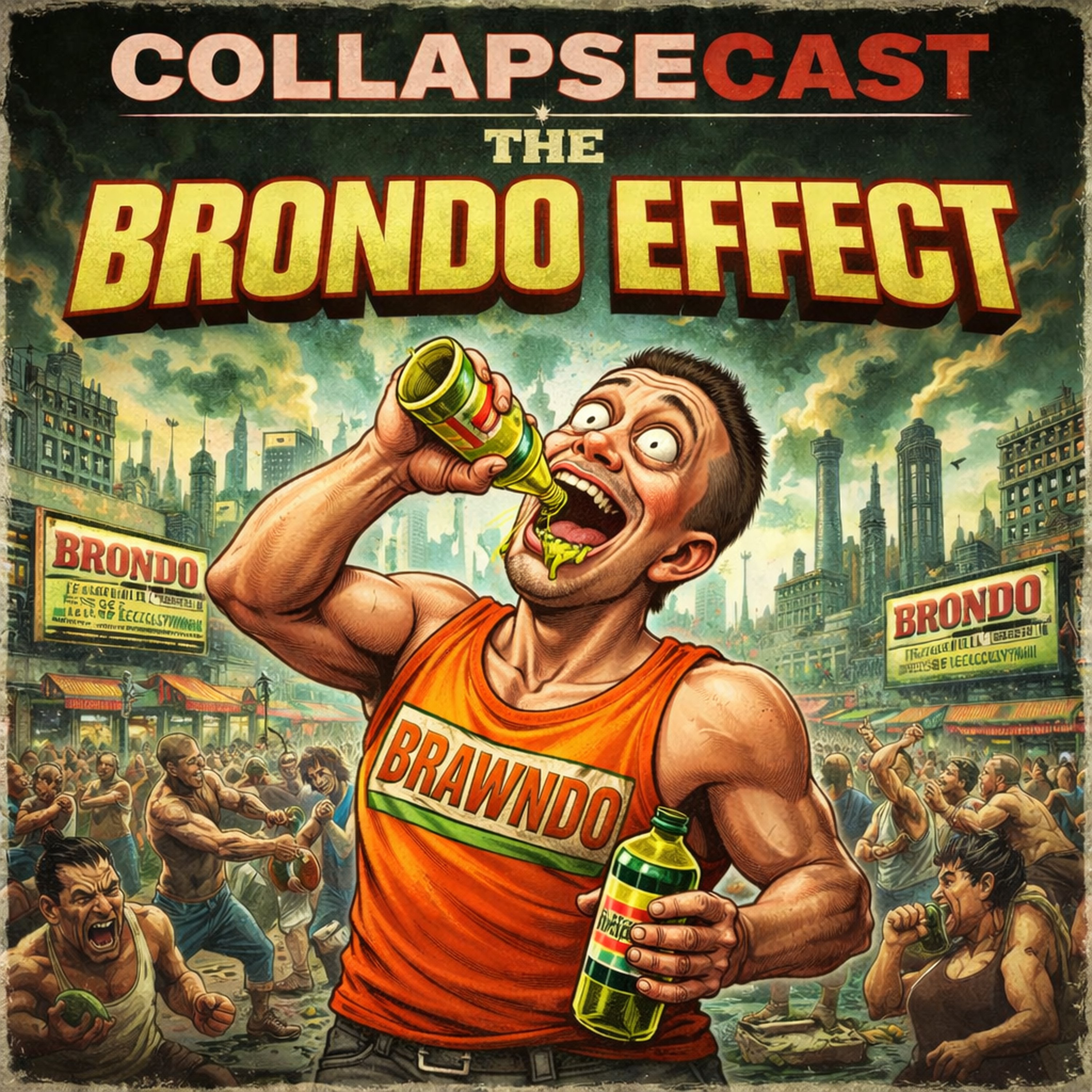
Because somewhere along the way, the world replaced water with Brawndo. A hyper-marketed, electrolyte-packed convenience product that "has what plants crave." Brawndo was not evil. No one forced it on anyone. It was optimized, advertised, and institutionalized. And by the time anyone noticed the problem, no one remembered why water mattered in the first place.
That is the Brawndo Effect. Not stupidity. Not ignorance. The loss of fundamental knowledge through comfortable substitution.
The most important thing about that scene is not that people were wrong. It is that they were confident. They trusted the system. They trusted the product. They trusted the messaging. They stopped questioning basic assumptions because questioning was no longer required.
Exaggeration only works as comedy when the audience believes the core idea is impossible. That is no longer true.
Cognitive Atrophy Is Already Happening
Consider navigation.
A few decades ago, getting somewhere required spatial reasoning. You built a mental map. You noticed landmarks. You understood direction, distance, sequence. Today, you follow a line on a screen.
GPS did not make people bad at navigation overnight. It made navigation unnecessary. And when a skill becomes unnecessary, the brain stops maintaining it. Research published in Frontiers in Psychology found that GPS dependency is positively associated with a poorer sense of direction and higher spatial anxiety. Studies examining lifetime GPS use found that greater GPS experience correlated with worse spatial memory during self-guided navigation — not because GPS users were less intelligent, but because the hippocampal pathways involved in building cognitive maps require active use to stay functional. Self-guided navigation engages the brain in ways that following turn-by-turn instructions simply does not.
Neural pathways strengthen through use. They weaken through neglect. This is not philosophy. It is physiology.
The same pattern applies to memory. Phone numbers, addresses, birthdays, appointments — these did not vanish because humans suddenly could not remember them. They vanished because remembering stopped being rewarded. External memory works, until it doesn't. And the cost is not just forgetting facts. It is forgetting how memory works. Humans do not just store information. They contextualize it, connect it, and interpret it. When memory becomes external, context dissolves. You no longer know something. You can access it. And access is not understanding.
AI tools follow the same logic. Copilots that write code. Models that draft emails. Systems that summarize documents you did not read. These tools are impressive, useful, and time-saving. But they also remove the need to struggle. And struggle is where competence lives.
When AI writes for you, you may still deliver output — but you do not exercise composition. When AI codes for you, you may still ship features — but you do not deepen understanding. When AI decides for you, you may still function — but you do not practice judgment.
This is the shift. The Brawndo Effect is not about automation replacing labor. It is about automation replacing thinking.
Who Benefits When Judgment Disappears
Everything above can still be explained as drift. Tools getting better. Humans relying on them a little too much. Skills fading through convenience rather than intent. That explanation is comfortable. It stops being comfortable the moment you ask who benefits from a population that no longer thinks independently.
Artificial intelligence does not replace manual labor first. It replaces judgment — analysis, planning, writing, coding, design, decision support. The jobs disappearing fastest are not physical. They are cognitive. They are the roles where humans were paid to think, not just act. CNBC reported in 2025 that AI is already taking white-collar jobs, with economists warning there is "much more in the tank." Microsoft's AI chief stated publicly that all white-collar work could be automated within 18 months. Employer-disclosed AI-attributed layoffs in the United States are estimated at 200,000 to 300,000 positions, with white-collar workers in financial analysis, legal review, and administrative roles among the most exposed.
When judgment is automated, humans stop being decision-makers. They become operators. And operators are easier to manage.
Once judgment centralizes in systems, a question emerges that modern societies have never had to solve at scale: what do you do with humans who are no longer economically necessary? Not zero — just fewer. A population that is not required to think, decide, or produce still has needs. They must eat, consume, and remain calm. Idle populations are only dangerous if they think. Dependent populations are predictable.
This is where narrative control becomes central. When people stop reasoning independently, they do not stop making decisions. They stop deciding how to decide. That gap gets filled for them. Algorithmic feeds do not optimize for truth. They optimize for reaction. Reaction bypasses reasoning. Emotion replaces analysis. And once humans rely on emotional cues to decide, decision-making collapses into binaries — red or blue, safe or dangerous, approved or unacceptable.
Research on recommendation algorithms confirms the mechanism. Users repeatedly exposed to content that confirms existing beliefs are less inclined to critically engage with alternative perspectives. Platforms have become the principal mechanism for information distribution, shifting from human editorial judgment to algorithm-driven curation. Complexity does not survive that environment. Simplified decisions scale better across large populations.
Confidence migrates from humans to systems. Not because systems are perfect — but because they are consistent. Humans are messy, slow, uncertain. Systems feel authoritative. Trust becomes dependence. And dependence becomes invisible as long as everything works. It reveals itself the moment something breaks.
Ask anyone who has lost GPS in an unfamiliar place. The panic is not about being lost. It is about not knowing how to get unlost.
What Can Actually Be Done
After all of this, one question becomes unavoidable: is any of it reversible?
At scale, institutionally, globally — no. The systems embedded here are too profitable and too convenient to be rolled back by a coordinated effort that does not exist and is not coming. But that is not the only question.
Collapse does not remove agency all at once. It erodes it through neglect. And anything that erodes through neglect can be resisted through maintenance.
The opposite of the Brawndo Effect is not rejection of technology. It is retention of competence. The line is not about using tools. It is about forgetting how to operate when the tools fail, lie, or disappear. The goal is not mastery. It is availability. You want judgment to still exist when you need it.
That means friction. Friction is the enemy of modern systems and the ally of human competence. Read long-form material without summaries occasionally. Write without autocomplete sometimes. Navigate without GPS once in a while. Solve a problem without asking a system what to do. Not always. Just enough to remind your brain that it still knows how. This is not nostalgia. It is maintenance.
The other form of resistance is slowness where it matters. Modern systems reward instant reaction — outrage now, decide now, share now. When you pause, you interrupt narrative control. You create space for reasoning to exist. You ask: who benefits from me reacting to this? What am I not being shown? That pause alone breaks the spell. Most narrative power collapses under inspection. But inspection requires time, and time is what these systems work hardest to take from you.
There is also something to the idea of growing something. Not as a lifestyle statement. Not to prove self-sufficiency. But because plants respond to reality, not to narrative. Soil, light, water, time. The garden does not care about trending topics. It does not adjust to engagement metrics. It responds to actual conditions. Tending something real forces the kind of attention, patience, and responsibility that optimized systems are designed to eliminate.
And yes — use water. That is not a joke. It is a reminder that the most basic truths are often the first things forgotten inside systems that have been optimized too efficiently in one direction.
You will not outpace what is being built. You do not need to. You just need to avoid being erased by it. Collapse does not require villains. It requires neglect. And the most powerful response to neglect is maintenance — of your own competence, your own reasoning, your own capacity to act without permission.
In a world optimized for dependence, that is not a small thing.
CollapseCast — The Brawndo Effect walks through the full arc: the Idiocracy parable and what it actually means, the documented mechanisms of cognitive atrophy in real time, the structural logic of why dependent populations are useful to centralized systems, and what practical resistance looks like without illusions about changing the world.