Artificial intelligence feels instant and weightless. It runs on power plants, water systems, and land. The gap between how it feels and what it costs is growing — and the systems underneath it were not designed for this.
There is a reason the industry settled on the word "cloud."
It implies lightness. Accessibility. Something that exists above the physical world, available on demand, without cost or weight. You open an app, type a question, get an answer. The interaction is so fast it leaves no room to wonder what had to happen for it to occur.
That framing was useful for adoption. It is not accurate as a description of what's actually happening.
Every interaction with an artificial intelligence system runs through hardware — physical processors drawing power, generating heat, demanding cooling, consuming water. The facilities housing that hardware operate continuously, regardless of whether anyone is actively using them, because the systems inside cannot be paused and restarted the way a laptop can. They run. All the time. At industrial scale.
That is what AI actually runs on. And the scale of it is changing faster than the infrastructure supporting it was designed to absorb.
The Buildout Is Already Happening
You can see the pressure this is creating without looking at any internal data. Just look at what grid operators are saying publicly.
The Electric Reliability Council of Texas, which manages the state's power grid, has projected that statewide demand could surge to nearly 368 gigawatts by 2032 — more than four times the state's current peak demand record of 85.5 gigawatts. That is not typical growth. That is a system being pushed beyond the assumptions it was designed around.
The primary driver is concentrated load from AI infrastructure and large-scale data centers. A single facility can draw hundreds of megawatts. When multiple facilities cluster in the same region — as they have been doing across Texas, Virginia, and several other states — the effect on local grid infrastructure compounds quickly. It does not just increase total demand. It creates pressure points that require new generation, expanded transmission, and long-term planning commitments simply to maintain stability.
The International Energy Agency projects global data center electricity consumption rising from roughly 415 terawatt-hours in 2024 to approximately 945 terawatt-hours by 2030, with AI workloads accounting for the largest share of that growth.
For context: that increase, taken alone, would represent more electricity than many mid-sized countries currently consume in an entire year.
What It Takes to Keep It Running
The power draw is the visible number. The full cost runs deeper.
Consider xAI's Colossus facility in Memphis, Tennessee — one of the largest AI compute deployments currently operating. The site runs at the scale of a major power station, with plans to expand toward two gigawatts of total capacity. At that level, nearly all of the energy consumed by the hardware becomes heat that must be removed continuously.
Cooling at this scale is not a secondary concern. It is a core engineering problem.
Inside the facility, liquid cooling circulates through densely packed GPU clusters to pull heat directly from the hardware. Outside, that heat moves through cooling towers and is released into the environment. Both processes depend on a continuous supply of water. At peak demand, the facility's water requirements were estimated near five million gallons per day.
To manage this without exhausting the local municipal water supply, xAI built a dedicated water recycling plant — costing tens of millions of dollars — that draws treated wastewater from a nearby treatment facility rather than potable drinking water. That plant requires its own energy to operate. Pumps, filtration systems, distribution infrastructure — all of it running continuously to support the layer above it.
Even within a recycling system, a significant portion of water used in evaporative cooling is lost to evaporation. It must be replaced. The loop is not closed. It requires constant replenishment.
Globally, AI data centers consumed an estimated 264 billion gallons of water in 2025. Projections from researchers at the University of California suggest that number could reach 9.3 trillion liters annually by 2030 if AI's share of data center workloads continues growing at current rates — enough to cover the basic domestic water needs of over a billion people for a full year.
That is the chain behind a single interaction.
Power to run the compute. Cooling systems to remove the heat. Water treatment to support the cooling. Additional power to run the treatment. Infrastructure to sustain all of it continuously, at scale, without interruption.
The Economics of Infinite Demand
The business model built on top of this infrastructure is facing its own kind of pressure.
OpenAI is reportedly spending over $34 billion in 2025 while generating $20 billion in annualized revenue. The company does not project cash-flow positivity until 2029. With only around 5 percent of its 800 million weekly users paying subscriptions, the gap between infrastructure cost and revenue recovery is significant enough that the company has publicly explored advertising as a path to close it.
The Oracle and OpenAI infrastructure partnership, valued at $300 billion, signals the scale at which this buildout is being funded. These are not technology investments in the traditional sense. They are infrastructure commitments — physical, long-term, and difficult to reverse once they are in place.
Once that infrastructure is built and connected, it becomes fixed load. Utilities commit to supporting it. Regional grids are planned around it. The systems built on top of it create dependency. That dependency raises the pressure to expand further.
The cycle reinforces itself.
What Access Looks Like Under Pressure
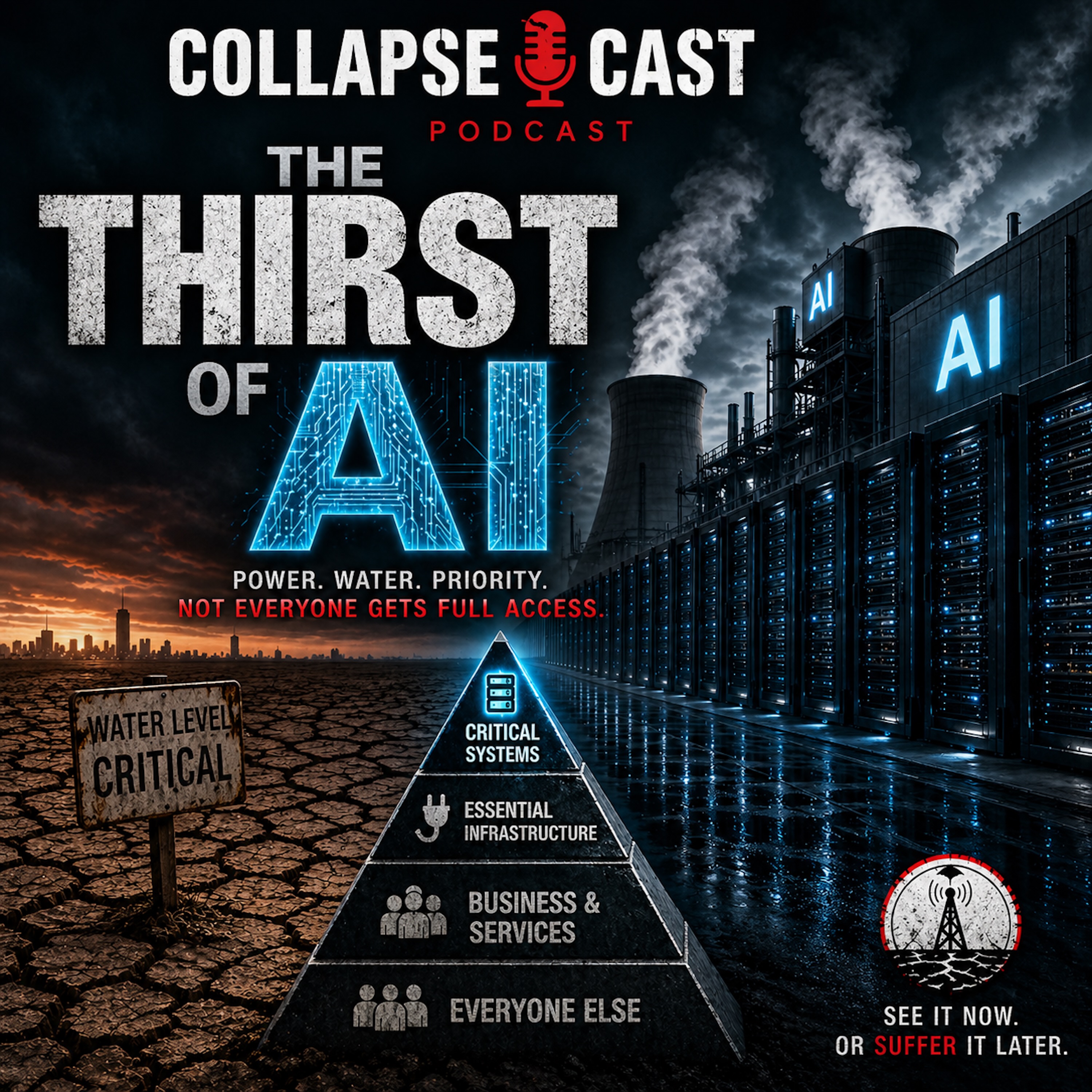
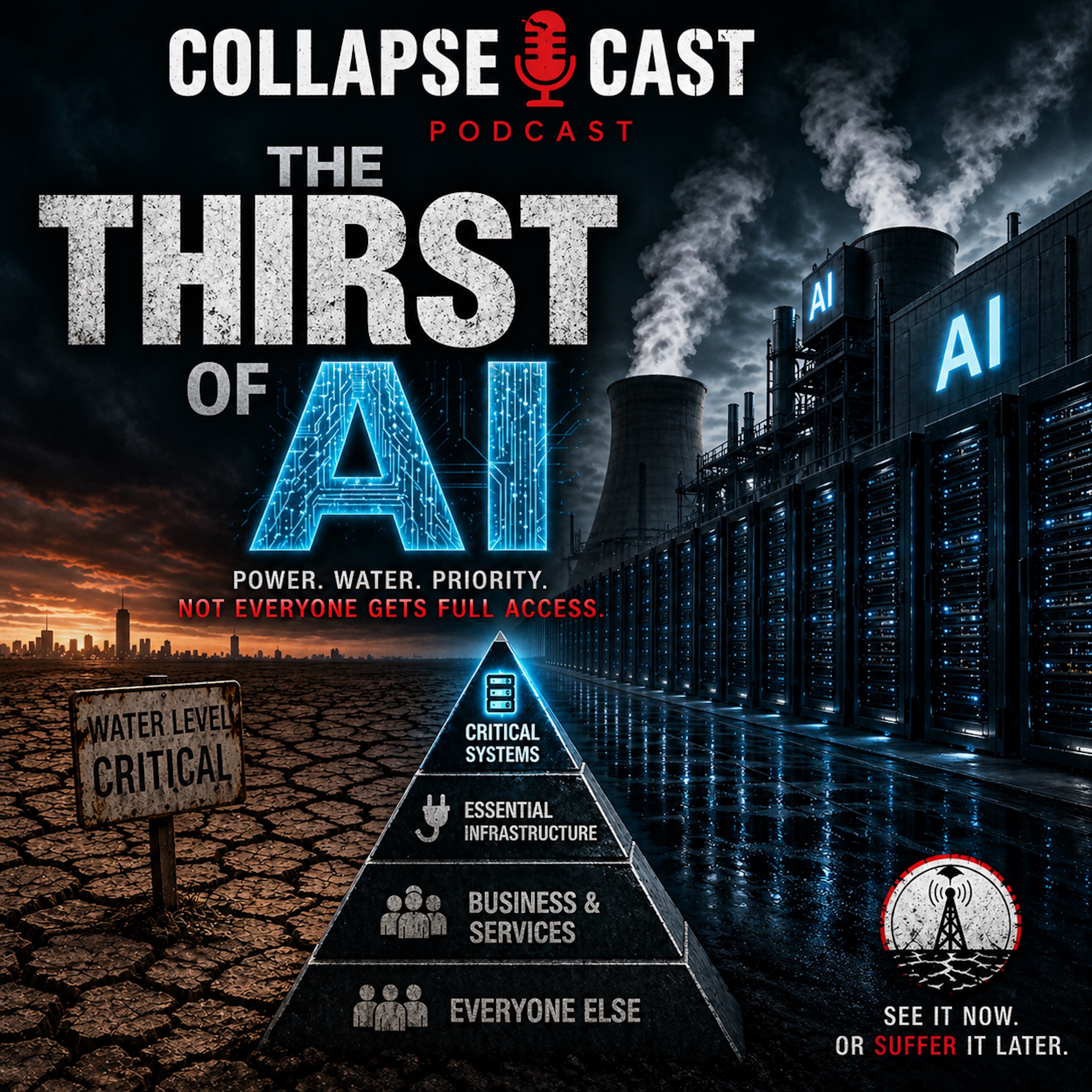
As demand continues growing against constrained infrastructure, access begins organizing itself around priority.
Users interacting with public-facing tools already see the edges of this. More timeouts. Slower responses during peak usage periods. Tightening limits on free tiers. Those are not random technical hiccups. They reflect how systems allocate limited capacity across a demand surface that is still expanding.
At the top of that hierarchy sit systems where interruption has real operational consequences — logistics, defense, financial infrastructure. These environments are provisioned to maintain performance under load. Below them, enterprise systems receive strong but bounded allocation. At the base, broad public access continues — but within whatever capacity remains after higher-priority workloads are sustained.
The system does not divide resources equally. It directs them.
Why This Is a CollapseCast Topic
The specific risk is not that AI stops working. It is that the systems supporting it were not designed for this level of concentrated, continuous demand — and the buildout required to close that gap is accelerating faster than the infrastructure underneath can reliably absorb.
Power grids were built around assumptions of distributed, variable load. Water systems were sized for existing populations. Grid expansion timelines run years to decades. AI infrastructure is being deployed in months.
When a system built on certain assumptions begins absorbing demand that exceeds those assumptions, it doesn't necessarily fail. It strains. Margins shrink. Redundancy erodes. Small disruptions that would otherwise have been absorbed become larger ones.
The same pattern that underlies every CollapseCast topic is visible here.
The infrastructure that supports modern civilization — grids, water systems, cooling capacity — is not infinitely elastic. It was built around a set of conditions. Change the conditions faster than the infrastructure can adapt, and the distance between the system's designed capacity and its actual load starts to become a vulnerability.
The technology is not the risk.
The gap between how fast the technology is growing and how fast the systems beneath it can follow — that is what's worth watching.
CollapseCast — Thirst of AI traces the full chain: the physical reality behind the cloud illusion, the xAI Colossus facility as a case study in what this looks like at scale, the grid projections that tell you how serious the industry believes this demand will get, and what tiered access patterns reveal about how a system behaves when demand begins to exceed what it was built to absorb.