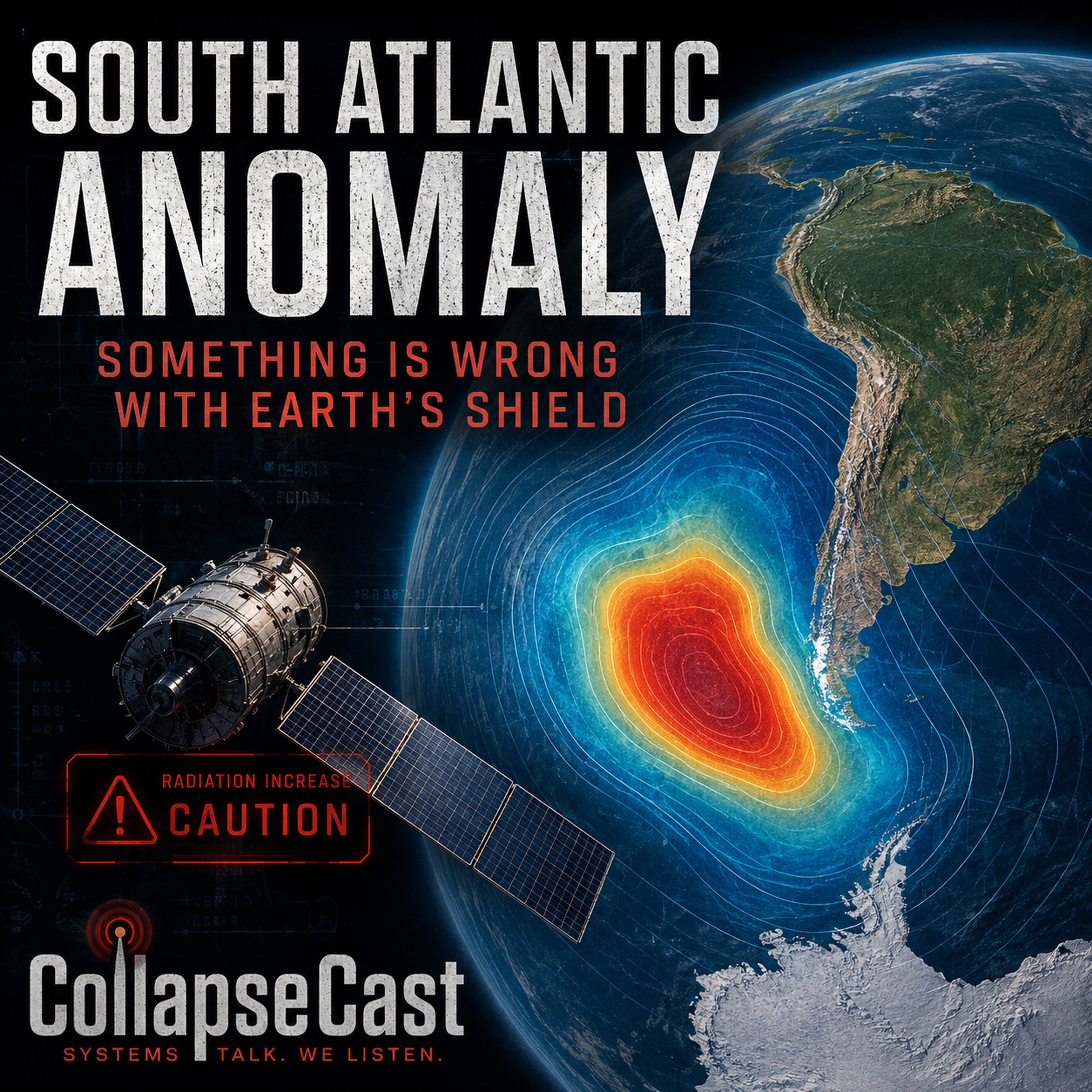
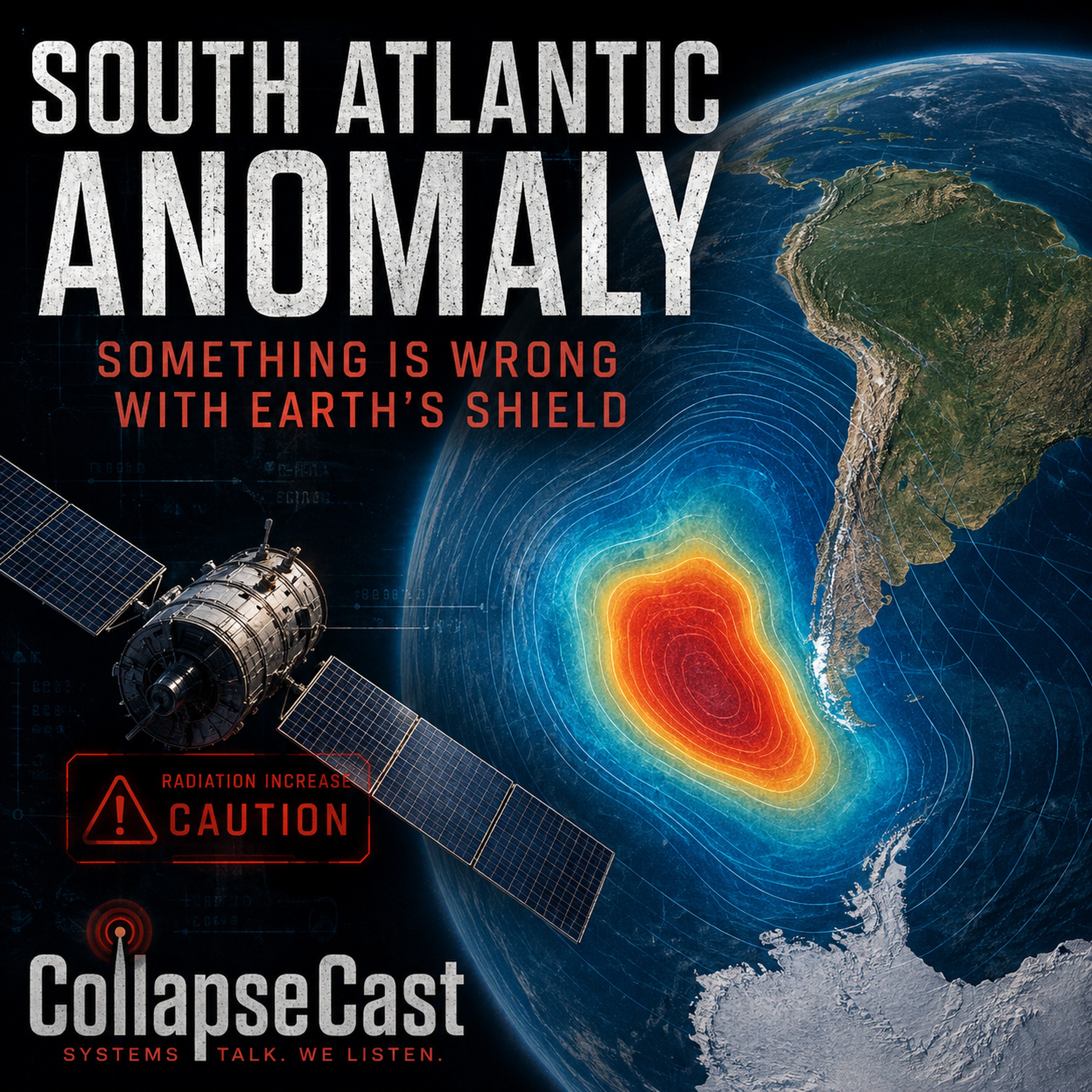
The magnetic shield protecting Earth from solar radiation is thinning over one of the most populated regions on the planet. Scientists have known for decades. The public largely hasn't.
There is a region of the planet — stretching from the coast of South America across to southern Africa — where Earth's magnetic shield has weakened by more than 30 percent. It has a name. It has been measured, mapped, and tracked by space agencies since the 1950s. The European Space Agency spent 220 million euros building a satellite constellation specifically to monitor it. NASA has it on their maps. Spacecraft have been quietly routing around it for decades.
It's called the South Atlantic Anomaly. You've probably never heard of it.
What It Is
Earth's magnetic field — generated by churning liquid iron in the planet's outer core — acts as a planetary shield, deflecting charged particles from the sun that would otherwise strip away the atmosphere over millions of years. This is not theoretical. Mars lost its magnetic field billions of years ago. The solar wind did the rest. Today Mars has an atmosphere less than one percent as dense as Earth's and no conditions for life.
The South Atlantic Anomaly is a region where that shield dips dramatically closer to Earth's surface than it should, leaving significantly less protection between the planet and what's constantly hitting it from space. It is not a hole. It is a thinning — a weak spot in the dome, expanding steadily over one of the most populated parts of the Southern Hemisphere.
What It's Already Doing
The consequences are not theoretical. They're operational.
The Hubble Space Telescope routinely powers down its sensitive instruments when its orbit carries it through the SAA. The elevated radiation in that region causes bit-flip errors — random data corruptions caused by charged particles punching through electronics. Powering down is the standard procedure. It has been for decades. The International Space Station passes through the anomaly on every orbit, and astronauts receive higher radiation doses during those crossings. ISS spacewalks are planned specifically to avoid SAA transits.
Satellites operating in the anomaly's zone age faster than satellites that don't. Hardware designed for a 15-year lifespan accumulates radiation damage at a higher rate. Satellite manufacturing lead times run three to five years — meaning the gap between a shortening lifespan and the replacement cycle is not a comfortable one.
On the ground, the atmosphere provides significant radiation shielding at sea level. But the effect is measurable and accumulating for populations living within the anomaly's footprint — large portions of Brazil, Argentina, Uruguay, and parts of southern Africa. At cruising altitude, commercial aviation crew flying routes through the South Atlantic region accumulate elevated radiation doses against guidelines set by the International Commission on Radiological Protection — guidelines that haven't been updated to reflect the weakening field since 1990.
How Long This Has Been Known
The anomaly was first identified in the early satellite era when engineers noticed consistent equipment anomalies in the same geographic pattern. Research on the SAA has accumulated for decades in geophysical journals. In 2013 the European Space Agency launched the Swarm satellite constellation — three dedicated spacecraft — specifically to monitor the state of Earth's magnetic field. The data Swarm has returned confirms the SAA is expanding, weakening, and showing signs of developing a second center of minimum field strength to its southeast.
In February 2019, an out-of-cycle update to the World Magnetic Model — the international standard used to calibrate GPS, aircraft navigation, and smartphone compasses — was issued a full year ahead of schedule. The magnetic north pole was moving so fast that the existing model had drifted outside acceptable accuracy limits. It was the first emergency update in the model's history.
What It Might Be Telling Us
The South Atlantic Anomaly sits over one region. But the magnetic field isn't just weakening there — it's weakening globally. The overall field has lost roughly nine percent of its strength in the last 170 years. The magnetic north pole is accelerating toward Siberia at rates not seen in recorded history. Researchers studying these data points note that they match the pattern documented in rock, ice cores, and sediment from periods preceding previous large-scale magnetic field transitions.
Whether the current trajectory ends in stabilization or something larger is a question geophysicists are actively working on. What isn't a question is the direction the data is pointing.
CollapseCast Episode 9 examines the full story — what the South Atlantic Anomaly is, what it's already doing to the infrastructure above it and the populations beneath it, how long the warning has existed without reaching public consciousness, and what the anomaly may be signaling about the broader state of Earth's magnetic field.