Navigation, wildlife, and a shifting field
How pole drift affects everything from compass apps to migration patterns.
Jul 18, 2026
0:00
–:––

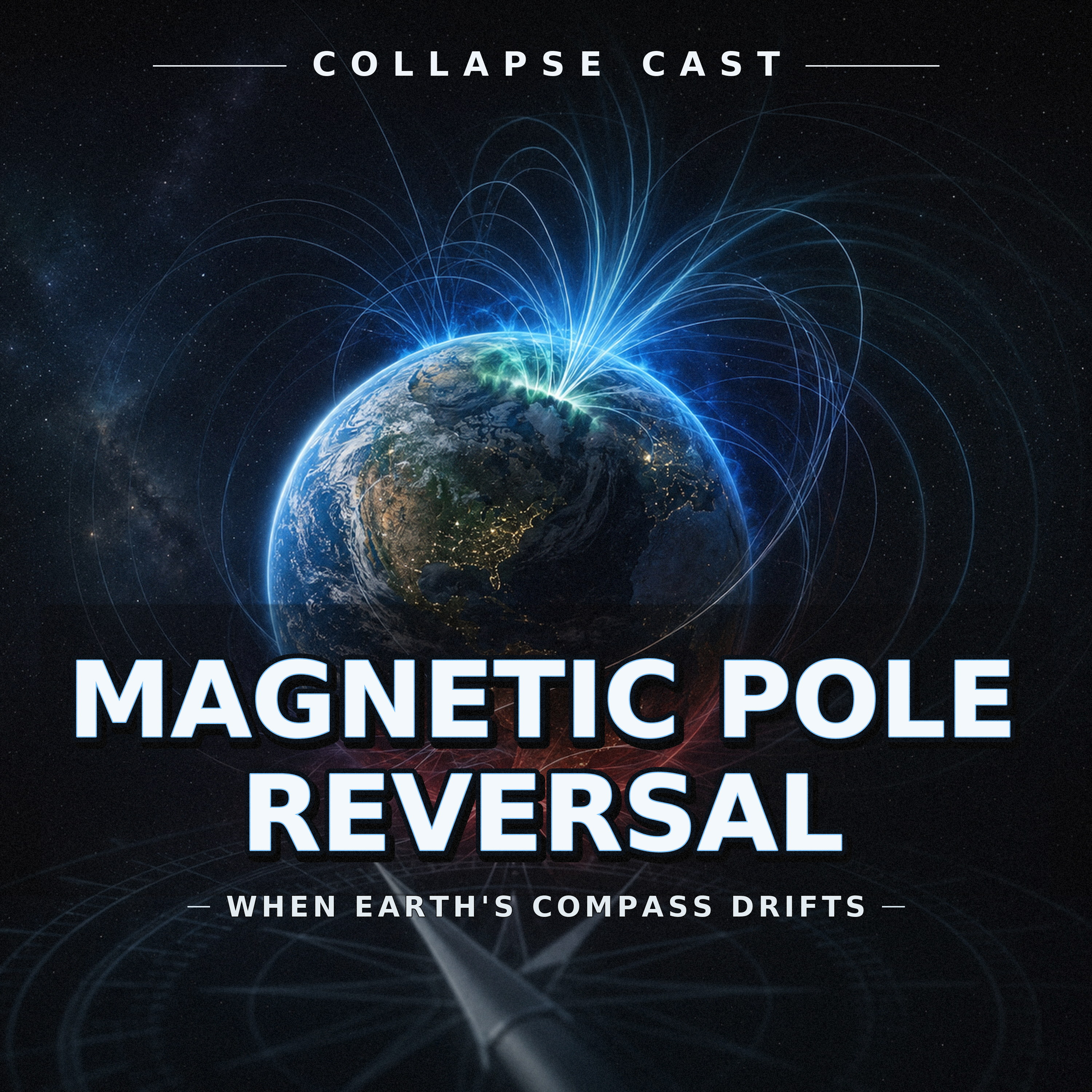
Earth's magnetic field has reversed hundreds of times. The last one completed 780,000 years ago. The average interval is 200,000 to 300,000 years. The field is already weakening — and the civilization sitting underneath it was never designed to survive one.
Navigation, wildlife, and a shifting field
How pole drift affects everything from compass apps to migration patterns.
Jul 18, 2026
In the early 1960s, survey ships dragging magnetometers across the Atlantic were mapping the magnetic properties of the rock beneath the seafloor. What they found was a pattern: on either side of the mid-Atlantic ridge, the seafloor rock was magnetized in alternating stripes — one pointing north, the next south, then north again, perfectly symmetrical on both sides, stretching for hundreds of miles.
Geologist Fred Vine understood what he was looking at. The mid-Atlantic ridge is a place where the ocean floor is constantly being created — magma pushing up from below, cooling into new rock, spreading outward in both directions. As that rock cools, the minerals in it lock in the direction of Earth's magnetic field at the moment of solidification. Like a tape recorder running at geological speed, the ocean floor had been capturing the state of the magnetic field for millions of years, one stripe at a time.
The stripes weren't a glitch. They were a history.
That history said Earth's magnetic poles had reversed repeatedly — north became south, south became north, hundreds of times across the geological record. The pattern has since been confirmed in ancient lava flows, sediment cores, and ceramics fired by early human civilizations that recorded the field direction at the time they were baked.
The reversals are not theory. They are a documented physical fact written into the planet itself.
What a Reversal Actually Is
Most people, hearing that the poles have flipped, picture something like a compass needle snapping to the opposite position — north becomes south on a given morning and life continues. That is not what happens.
A reversal is a process. It unfolds over thousands of years. It begins with the field weakening globally — not in one region, but everywhere. The smooth, organized structure of the magnetosphere begins to break down. The dominant poles lose their grip. Secondary poles start appearing in unexpected locations. Studies of past reversals in the sediment record have found signatures suggesting that during some transitions the field fragmented into as many as six simultaneous poles scattered across the planet, each competing with the others, none of them stable.
A compass in that environment doesn't point north. It doesn't point south. It points toward whichever competing pole is locally dominant — and that changes depending on where you're standing. Magnetic north as a navigational concept doesn't become inverted during a reversal. It becomes meaningless.
While this is happening, the overall strength of the field drops dramatically. Studies of the rock record from previous reversals show the field potentially weakening to ten percent of its current strength during the transition. The evidence is preserved in ice: Antarctic and Greenland ice cores trap air bubbles as each year's snowfall compresses, creating a record of atmospheric chemistry stretching back hundreds of thousands of years. Layered within that record are signatures of elevated radiation — periods where cosmogenic isotopes produced when high-energy particles hit the atmosphere spike measurably above baseline. Those spikes correspond precisely to periods of known magnetic field weakness. During the transitions, more got through.
The Laschamps Excursion
A full reversal — where north permanently becomes south — is the extreme end of this story. The closer and more realistic near-term scenario is called a geomagnetic excursion: the field weakens, the poles wander, the chaos begins, but the reversal doesn't complete. The field eventually restabilizes without fully flipping.
This has happened before. The Laschamps excursion, about 42,000 years ago, dropped the field to roughly five percent of its current strength for several centuries before recovering. The aurora appeared at the equator. Researchers reading sediment cores from that period found the temperature record, the precipitation record, and the magnetic record all moving together in the same layers — not because of volcanic activity or orbital mechanics, but because the electromagnetic environment of the planet changed and the atmosphere responded. Climate disruption signatures line up directly with the magnetic transition.
The populations living through the Laschamps had no instruments sensitive enough to see what was happening. They had no framework for understanding it. The disruption was invisible to them until it wasn't.
The excursion scenario is not the less serious version of this story. It is the realistic near-term version. And it breaks things in the same sequence a full reversal would.
What the Current Measurements Show
Geophysicists studying past reversals have identified a consistent fingerprint that appears before a transition begins — not during, but before. The field weakens globally. The dominant poles begin moving faster than their historical average. Regional anomalies of reduced field strength appear and expand. The overall structure of the magnetosphere becomes less organized, less stable, more variable.
Run that list against the current measurements.
Global field strength is down nine percent over the past 170 years, with the rate of decline accelerating. ESA's Swarm satellite constellation, launched specifically to monitor the field in high resolution, is tracking this in real time. The magnetic north pole has been accelerating for decades — moving fast enough that the international World Magnetic Model, the navigational standard used by GPS systems, aviation, and shipping worldwide, required an emergency out-of-cycle update in 2019 because the pole had drifted beyond acceptable error margins ahead of schedule. The South Atlantic Anomaly — a massive region of dramatically weakened field centered over South America and the South Atlantic — is expanding, deepening, and showing signs of splitting into two separate centers of weakness.
None of these individually constitutes proof of an imminent transition. Together, they match the fingerprint that precedes one in the geological record.
The Warning That Was Filed
On September 1 and 2, 1859, a British astronomer named Richard Carrington was sketching sunspots through his telescope when he observed something nobody had ever recorded — a sudden, intense flash of white light erupting from the sun's surface. Seventeen hours later, telegraph systems across North America and Europe failed simultaneously. Operators reported receiving electrical shocks. Some telegraph machines kept sending messages after being disconnected from their power source — running on the current the geomagnetic storm was driving through the lines. The aurora appeared as far south as Cuba and Hawaii. People in the northeastern United States read newspapers outside at midnight by the light of it.
That was the Carrington Event — the largest recorded geomagnetic storm in history. It hit a planet whose most sophisticated electrical infrastructure was the telegraph.
In 2008, the National Academy of Sciences published a study answering a specific question: what would a Carrington-scale event cost if it hit today? The answer was one to two trillion dollars in the first year alone. Full recovery: four to ten years. Not because the storm lasts that long — a geomagnetic storm is over in days. But because the extra-high-voltage transformers that form the backbone of the power grid are custom-built, manufactured in small quantities, and take one to three years each to replace. Most are built overseas. If enough fail simultaneously, the replacement queue outlasts the grid's ability to wait.
The mechanism is straightforward. Geomagnetically induced currents flow through long-distance transmission lines across the entire network at once — the longer the line, the more current it picks up. Those currents are effectively direct current. The high-voltage transformers at the backbone of the grid weren't built for DC. Running it through them generates heat in the core. Enough heat, sustained long enough, and the transformer fails — sometimes permanently.
That 2008 report went to Congress. It was not classified. It was not buried. Legislators read it. Utility regulators received it. In 2016, FERC — the Federal Energy Regulatory Commission — issued a formal order requiring utilities to develop protection plans. The utilities submitted plans. The plans mostly described monitoring — systems to detect when a storm was occurring so operators could respond in real time. What the plans largely didn't describe was physical hardening of the transformers and transmission lines to survive the event in the first place.
Hardening is expensive, requires taking equipment offline, and produces no visible benefit until the moment it prevents a catastrophe. So it gets deferred. The knowledge is present. The risk is documented. The math favors hardening. The grid today is not meaningfully more prepared than it was when that 2008 report landed on congressional desks.
The Cascade
Here is why a weakening field makes all of this worse. Geomagnetic storms already happen under normal conditions — caused by solar activity interacting with whatever field strength exists at the time. A weaker field means the same solar event drives larger induced currents through the grid. The damage threshold drops. Events that were manageable become serious. Events that were serious become catastrophic.
The 2003 Northeast blackout started with a software bug in Ohio. One node. Fifty-five million people without power. The cascade moved from Ohio through New York, into Canada, down through the mid-Atlantic in under eight minutes. A major geomagnetic storm doesn't hit one node. It hits the entire grid simultaneously.
If enough transformers fail at once, the recovery window is measured in years, not weeks. And during those years, everything that depends on electricity operates at degraded capacity or not at all: water treatment, food refrigeration, hospital equipment, heating and cooling, communications, fuel pumping, and the supply chains moving everything else — including the parts needed to rebuild the grid itself.
None of that happens because of the magnetic field directly. It happens because the grid went down and can't come back fast enough.
Navigation compounds the problem. GPS signals travel through the ionosphere — the charged upper layer of the atmosphere that the magnetic field shapes and maintains. A disturbed, weakening field means a disturbed ionosphere. That introduces errors into GPS positioning that can't be corrected the way normal atmospheric delays can. The more chaotic the field, the larger and less predictable those errors become. Aviation, maritime shipping, precision agriculture, emergency services, military operations — every sector that built itself around reliable GPS is exposed, without any meaningful policy response attached to that specific vulnerability.
The Svensmark Thread
There's a connection that doesn't get enough attention because it sits at the edge of the mainstream scientific conversation. It connects the magnetic field to weather.
In the 1990s, Danish physicist Henrik Svensmark proposed that cosmic rays — high-energy particles streaming in from deep space — play a role in cloud formation. The mechanism: cosmic rays ionize air molecules in the lower atmosphere, and those ionized molecules act as seeds around which water vapor condenses into cloud droplets. More cosmic rays reaching the lower atmosphere means more cloud nucleation, which affects temperature gradients, precipitation patterns, and the circulation systems that drive weather.
The flux of cosmic rays reaching Earth's lower atmosphere is regulated by the magnetic field. A stronger field deflects more away. A weaker field lets more through. A weakening magnetic field is therefore a variable in the atmosphere — a planet with a weakening field is a planet with altered cloud formation dynamics, operating differently than it did when the field was stronger.
CERN ran a dedicated experiment — the CLOUD experiment — specifically to test the Svensmark mechanism under controlled conditions. The results supported the core hypothesis. Cosmic ray ionization does influence cloud formation. The effect is real. The magnitude of its influence on global weather patterns remains debated, but the mechanism is documented physics, not fringe speculation.
And the Laschamps record backs it up. The climate disruption signatures from that period line up with the magnetic transition. Weather responded when the field dropped.
Where This Leaves Us
A transitional state in the magnetic field does not begin on a specific morning. It develops gradually, across decades and centuries, one measurement at a time. The field weakens a fraction of a percent per year. The pole moves a few more miles than the year before. The anomaly grows in increments too small to feel but large enough to measure. Weather patterns shift in ways that don't quite fit the old models.
You don't know you've entered a transitional state by experiencing a threshold event. You know it in retrospect, when enough of the incremental changes have accumulated to make the pattern undeniable. By the time the pattern is undeniable, you've been inside it for a while.
The field is weaker than it was 170 years ago. The pole is moving faster than it was 30 years ago. The anomaly is larger than it was 50 years ago. The rate of change on all three measures is accelerating.
The last time Earth went through a period like this, the most sophisticated structure human beings had built was a shelter made of wood and animal skin. No power grid. No satellites. No supply chains. No infrastructure of any kind that assumed a stable magnetic field to function.
The geological record shows life survived every previous reversal.
The geological record has never been tested against a civilization.
CollapseCast — The Flip is Episode 10 of the series, completing a two-episode arc on Earth's magnetic field. Episode 9 covered the South Atlantic Anomaly as the current visible warning sign. This episode examines the larger pattern it may belong to — a geological process that has happened hundreds of times, appears statistically overdue, and would encounter infrastructure that was never designed to account for it.
Fred Vine & D.H. Matthews (1963) — Magnetic Anomalies Over Oceanic Ridges — Nature
https://www.nature.com/articles/199947a0National Academy of Sciences (2008) — Severe Space Weather Events: Understanding Societal and Economic Impacts
https://nap.nationalacademies.org/catalog/12507/severe-space-weather-events-understanding-societal-and-economic-impactsNOAA / British Geological Survey — World Magnetic Model Out-of-Cycle Update (2019)
https://www.ncei.noaa.gov/news/out-cycle-update-world-magnetic-modelUSGS — Geomagnetism Program: — Historical Variations in Earth's Magnetic Field
https://www.usgs.gov/programs/geomagnetismCooper et al. (2021) — A Global Environmental Crisis 42,000 Years Ago — Science
https://www.science.org/doi/10.1126/science.abe8677Svensmark & Friis-Christensen (1997) — Variation of Cosmic Ray Flux and Global Cloud Coverage — Journal of Atmospheric and Solar-Terrestrial Physics
https://www.sciencedirect.com/science/article/abs/pii/S1364682696001015CERN — CLOUD Experiment: — Cosmic Rays and Cloud Formation
https://home.cern/science/experiments/cloudNASA Earth Observatory — Earth's Inconstant Magnetic Field
https://earthobservatory.nasa.gov/features/MagneticFieldNERC (2012) — Effects of Geomagnetic Disturbances on the Bulk Power System
https://www.nerc.com/pa/Stand/Geomagnetic%20Disturbance%20Resources%20DL/2012GDR.pdf