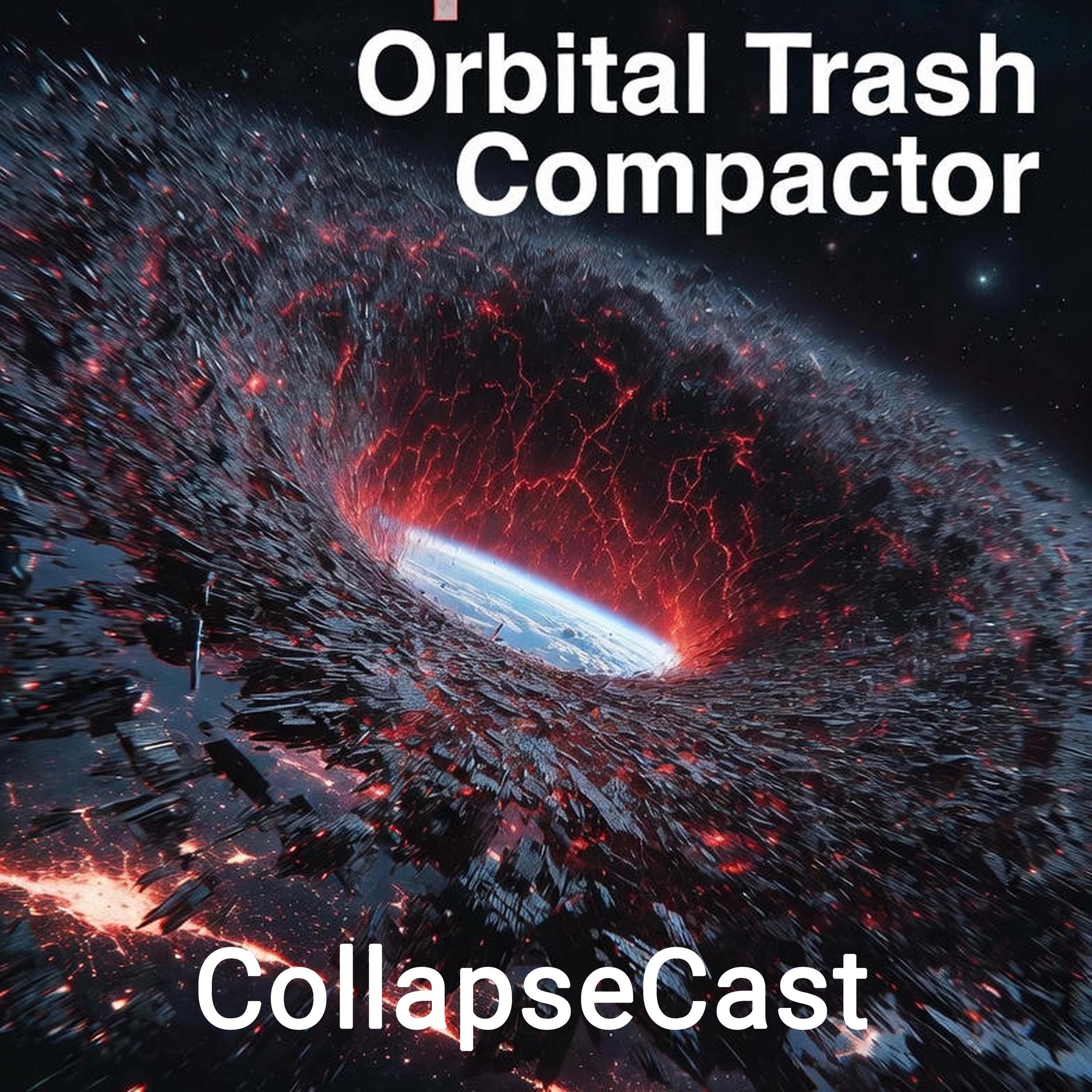
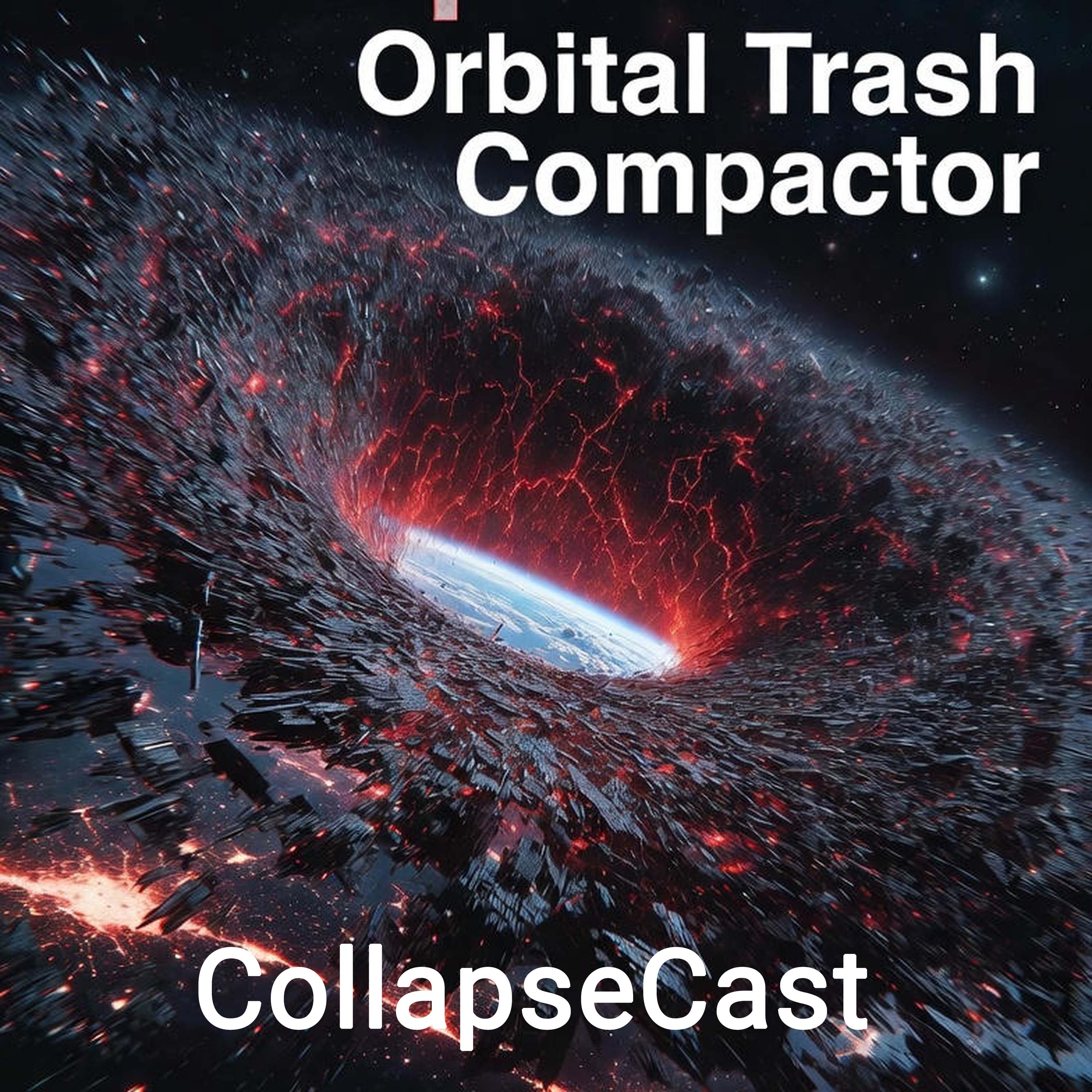
In 1978, a NASA scientist warned that if we kept littering low Earth orbit, one day the collisions would feed themselves forever. We nodded, filed the paper, and launched thirty thousand more satellites anyway.
In 1978, a NASA researcher named Donald Kessler published a paper in the Journal of Geophysical Research with his colleague Burton Cour-Palais. The paper was titled "Collision Frequency of Artificial Satellites: The Creation of a Debris Belt." The premise was straightforward: beyond a critical density of objects in a given orbital shell, collisions become self-sustaining. Each collision produces thousands of new fragments. Those fragments cause more collisions. The curve stops being a line and becomes a hockey stick. Once that process starts, there is no off-ramp for centuries.
NASA established the Orbital Debris Program Office at Johnson Space Center a year later and made Kessler its head. The warning was logged, cited, and understood by the technical community.
Then humanity launched thirty thousand more satellites anyway.
What Is Actually Up There
Low Earth Orbit is not "space" in the way most people picture it. It is a narrow, crowded racetrack between 200 and 2,000 kilometers above the surface where everything is trying to go the same direction at the same insane speed. Cross-traffic at 17,500 miles per hour has no fender benders. Every collision releases energy equivalent to multiple tons of TNT and turns two objects into hundreds of thousands of pieces.
ESA's 2025 Space Environment Report puts the current census at approximately 40,000 tracked objects larger than 10 centimeters, of which roughly 11,000 are active satellites. Below the tracking threshold: roughly 1.2 million objects between one and ten centimeters — the "dark inventory" that radar cannot reliably see but that is large enough to destroy any spacecraft on impact — and over 130 million shards smaller than one centimeter, each carrying the kinetic energy of a .38 round. Total man-made mass in orbit: over 11,000 metric tons.
Starlink alone accounts for more than 7,000 of the active satellites. Amazon's Project Kuiper has 3,200 approved. China's Guowang mega-constellation has 13,000 planned. Over 100,000 new satellites are licensed and coming in the next decade. Nearly all of them are being parked in the altitude bands between 550 and 1,200 kilometers — already the most crowded zones, with the longest natural debris lifetimes. At 550 kilometers a dead satellite might decay in five to seven years. At 1,100 kilometers, it will stay in orbit for centuries.
The CRASH clock — a metric tracking how frequently a major collision-triggering event becomes statistically expected — has dropped from 121 days in 2018 to 2.8 days as of 2025.
ESA's 2025 report uses the phrase "irreversible deterioration" for the 800–1,000 kilometer shell. NASA's Orbital Debris Program Office has stated that the environment is "no longer stable." The U.S. Space Force labels low Earth orbit "contested and congested." Meanwhile, the launch manifests keep growing.
How the Cascade Actually Works
The physics are simple. Once debris density hits the tipping point, collisions start happening faster than atmospheric decay can clear the pieces. Each collision produces thousands of new fragments. Those fragments cause more collisions. The environment gets worse even if every nation and company stops launching entirely.
A single large collision — a dead two-ton rocket body crossing paths with an operational satellite at relative speed of 14.5 kilometers per second — releases energy equivalent to 12 to 15 tons of TNT in the span of a ten-thousandth of a second. The two objects vaporize into a plasma cloud that expands into 6,000 to 10,000 new trackable fragments and hundreds of thousands of smaller ones. Every satellite operator on Earth gets conjunction warnings. SpaceX already performs an estimated 300,000 collision avoidance maneuvers per year, according to filings with the Federal Communications Commission.
Using ESA's DAMAGE modeling tool and NASA's LEGEND models, researchers project median timelines under current conditions: one to two Iridium-Kosmos-class collisions per year by 2035, one every four to six months by 2045, and multiple per month by 2060. At that point the debris population grows exponentially regardless of what humanity does next.
The end-state is not science fiction. It is an environment where low Earth orbit becomes statistically unusable. GPS accuracy degrades from meters to kilometers, then fails entirely as the constellation dies piecemeal. Global broadband coverage — Starlink, Kuiper, OneWeb — goes dark. Polar-orbiting weather satellites disappear, pushing hurricane track errors from 60 kilometers to 300 or more. Cell networks, power grids, and financial markets that synchronize to GPS timing signals face rolling instability. Every major military power loses real-time overhead imagery simultaneously. The global economy, which built itself on the assumption of reliable space infrastructure, discovers that the assumption was wrong.
The Space Data Association estimates total economic losses at over one trillion dollars if the cascade becomes reality. ESA's own models put the 50-year global GDP loss in the range of one to three trillion in the optimistic scenario — the one where some higher orbits remain accessible.
Why the Solutions Are Not Enough
Every realistic option is on the table. None of them are working at the scale required.
The international 25-year deorbit guideline has been in place since 2002. It is completely voluntary, carries no fines, and has no enforcement mechanism. Compliance is inconsistent across operators and essentially nonexistent across competing space powers.
Active debris removal missions are being developed. ESA's ClearSpace-1 mission — now targeting 2028 — plans to grab a single rocket stage with a net, at a budget of roughly 150 million euros for that one object. Japan's Astroscale is developing magnetic capture systems. A handful of startups are working on robotic arms and harpoons for the 2027–2030 timeframe. Total objects planned for removal in the next decade: 30 to 50. Objects required to stabilize the environment: a minimum of 200 per year per altitude band, indefinitely.
Starlink itself has designed newer satellites to deorbit within five years if healthy. But older generations don't meet that standard, early failures drift for decades, and no competing constellation — Chinese, Russian, or Amazon — is matching even that commitment.
The governance gap is the actual bottleneck. Every technical solution requires either global enforceable law with real teeth, or one superpower willing to fund cleanup of everyone else's mess. The UN Committee on Peaceful Uses of Outer Space moves slowly and has no enforcement authority. The U.S. will not impose orbital liability bonds that constrain its own national champions. China and Russia will not accept inspections while American companies dominate commercial space. Insurance companies are beginning to refuse coverage above 600 kilometers, which pushes constellations higher — where decay times are measured in millennia.
ESA's 2025 report concludes: "Without immediate and drastic measures, parts of LEO will become unusable within decades." The Secure World Foundation's 2025 assessment called the current trajectory "the largest uncontrolled experiment in history with no off-ramp." NASA's private briefings to Congress put the best-case scenario — with aggressive removal — at losing 30 to 50 percent of low Earth orbit satellites by 2070.
The window in which prevention is still cheaper than cure is estimated at four to nine years.
Why This Is a CollapseCast Topic
The pattern is precise. A system gets built around an infrastructure that works so reliably it becomes invisible. Dependency deepens across every layer of civilization — commerce, military, agriculture, emergency response, communications. And the vulnerability that threatens that infrastructure accumulates quietly in the background, understood by the technical community, unactionable by any political system capable of moving fast enough to matter.
Donald Kessler filed the warning in 1978. It was published, cited, and understood. The Orbital Debris Program Office was created. The modeling was done. The timelines were calculated. And the launch manifests kept growing, because the profits exist now and the consequences arrive later — after the companies are gone, after the politicians are gone, after the window has closed.
The sky above your head is filled with infrastructure. Your phone, your bank, your weather forecast, your navigation, your ambulance dispatch. All of it depends on a web of metal and glass traveling at 17,500 miles per hour through a growing cloud of fragments moving just as fast in the opposite direction.
Once the cascade is visibly underway — once multiple large collisions are happening per year — removal becomes impossible. The sky is too dangerous to fly garbage trucks through. By the time the failure is undeniable, the recovery window is already gone.
CollapseCast — Orbital Trash Compactor walks through the full mechanics of Kessler Syndrome: the debris census, the cascade timeline, what the end-state actually looks like on the ground, every mitigation option currently on the table and why none of them are scaling fast enough, and the governance failure that sits underneath all of it.