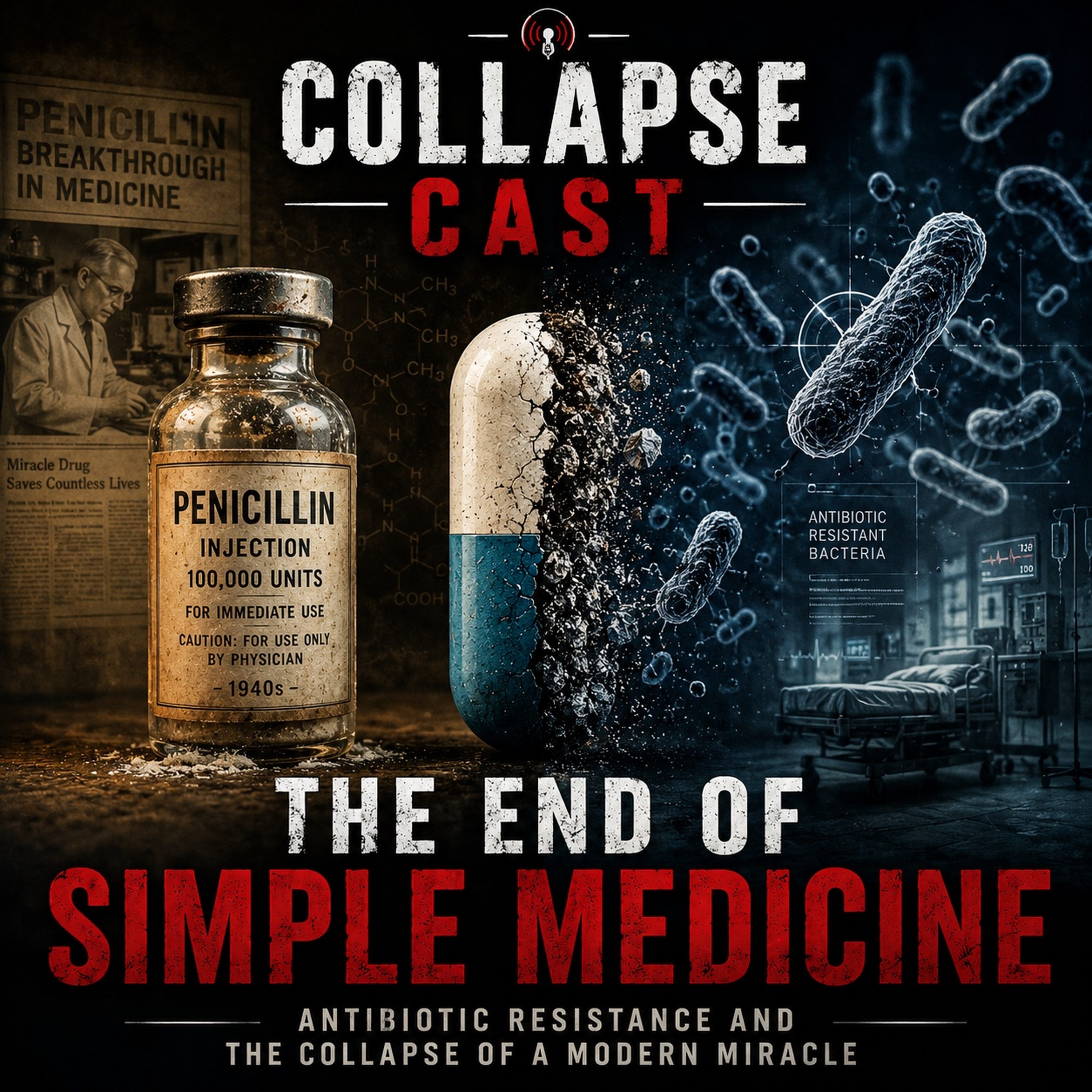
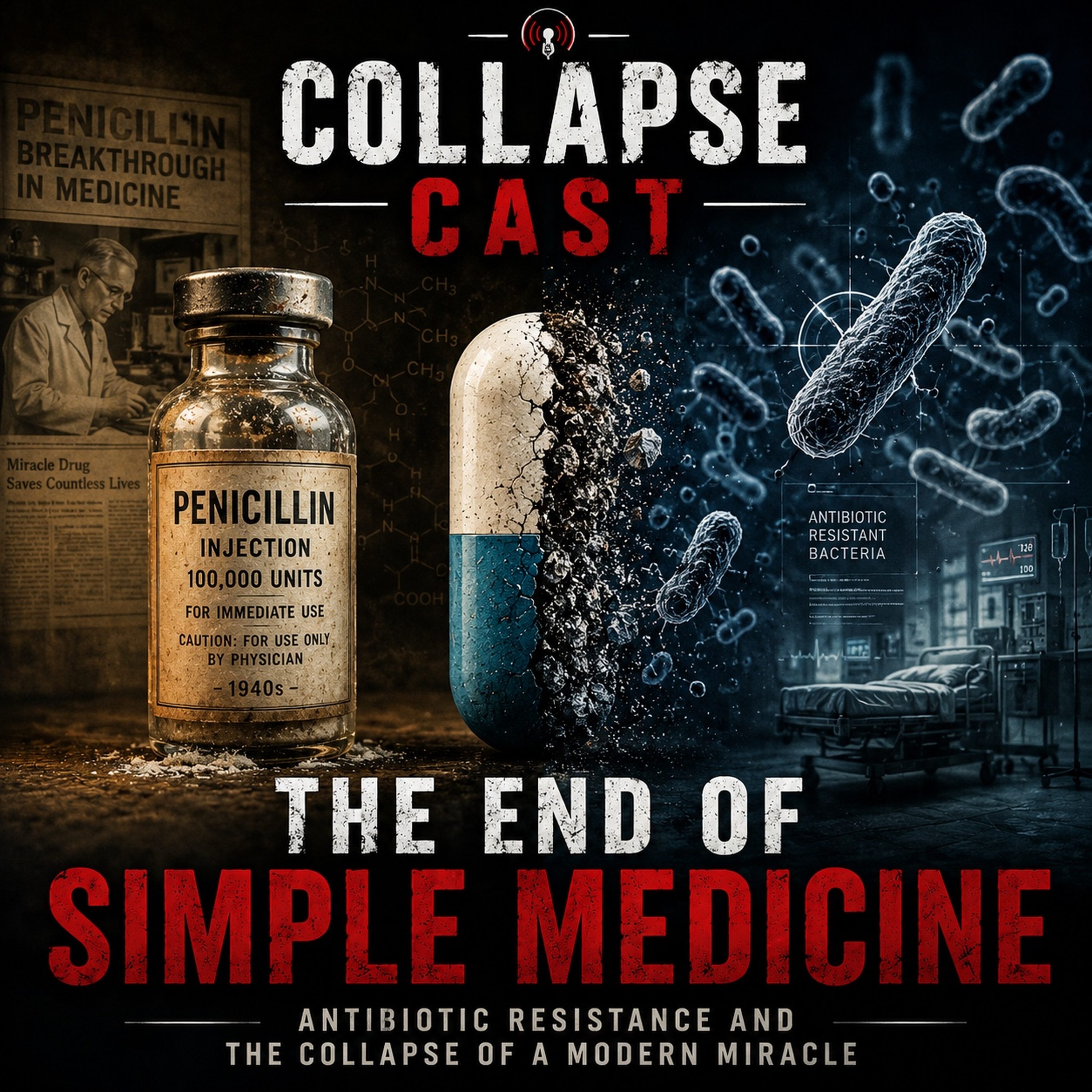
For nearly a century, antibiotics were one of civilization's invisible foundations. We built an entire world around the assumption they would keep working. That assumption is now in question.
There is a moment in Fleming's 1945 Nobel Prize lecture that most people have never read.
He had just accepted recognition for discovering penicillin — one of the most consequential medical breakthroughs in human history. He stood at the podium and warned his audience directly: expose bacteria to antibiotics in doses too low to kill them consistently, and you will produce resistant strains. He had already seen it happen in his own laboratory. He said it plainly.
The scientific community heard him.
And then the world kept prescribing penicillin, because the warning was abstract and the results were real. Patients who had been dying were surviving. Infections that had terrified previous generations were clearing in days. The evidence in front of doctors every morning was overwhelming.
Warnings about what might happen eventually are very difficult to hear when what is happening right now is saving lives.
That dynamic — visible success obscuring a slow-building structural problem — is exactly what makes antibiotic resistance a CollapseCast topic.
What Antibiotics Actually Did
To understand what losing them means, you have to understand what they replaced.
Before antibiotics, bacterial infection was one of humanity's most reliable killers. A minor cut could become fatal once bacteria entered the bloodstream. A tooth infection could spread and kill an otherwise healthy adult. Childbirth carried substantial mortality risk because infection frequently followed delivery. Surgery was constrained not by skill or knowledge but by the simple fact that once infection gained a foothold, medicine often ran out of options.
Penicillin changed the math.
For the first time, doctors possessed a reliable tool against infections that had killed people throughout recorded history. Diseases that routinely ended lives became manageable. Procedures once considered reckless became realistic. Modern surgery, trauma care, cancer treatment, organ transplantation — all of these expanded because bacterial infection stopped representing the same level of threat it always had.
Antibiotics became invisible the way electricity becomes invisible. Present, essential, and invisible precisely because they worked so consistently.
That invisibility is the problem.
How Bacteria Found a Way
Understanding antibiotic resistance requires understanding something most people never think about: when a doctor prescribes an antibiotic, the drug does not enter a sterile environment. It enters a living ecosystem.
Inside an infected body, there may be millions — sometimes billions — of individual bacteria. They are not identical. Living populations carry variation, and that variation is random, constant, and ancient. Most bacteria in an infection are vulnerable to the antibiotic. A small number may not be — not because they planned it, but because variation is how life works. Some carry a slightly different protein structure, a chemical mechanism that expels the drug before it can cause damage, or a cell wall the antibiotic can't penetrate.
The antibiotic kills the vulnerable ones.
The survivors reproduce.
A single bacterium can become millions within hours. A population that once represented a tiny fraction of the whole becomes the dominant strain within days. The antibiotic did not create resistance. It selected for it — the same mechanism that makes weeds resistant to herbicides and insects resistant to pesticides.
The timescale is what makes bacteria different. Humans reproduce once a generation. Bacteria reproduce every twenty minutes under the right conditions. Evolution that might take millennia in larger organisms can happen inside a single patient in a matter of weeks.
And resistance doesn't stay put. Bacteria can transfer resistance traits directly to neighboring bacteria — including entirely different species — without reproduction. A resistant strain in one hospital in one country can share that advantage with organisms halfway around the world within years.
Every antibiotic used anywhere is a selection event. Every prescription, every course left unfinished, every farm animal given low doses to promote growth rather than treat disease — each one is a small pressure applied to an enormous population moving at extraordinary speed.
Fleming saw all of this in 1945.
What It Looks Like Now
For most people, antibiotic resistance still sounds like something that happens somewhere else. Most infections are still treated successfully. Most prescriptions still work.
That is exactly why the problem remains easy to underestimate.
The warning doesn't arrive as a dramatic event. It arrives through exceptions. A treatment takes longer than expected. A second antibiotic is needed after the first fails. A patient remains hospitalized because recovery isn't progressing the way it should.
Methicillin-resistant Staphylococcus aureus — MRSA — became the most recognizable face of this. A common bacterium that accumulated enough resistance to ignore the drugs physicians once used against it reliably. Patients with MRSA infections often require longer hospital stays, more aggressive treatment, and extensive testing simply to achieve outcomes that were once routine.
But MRSA is not the most serious example.
Carbapenem-resistant bacteria — CRE — represent a more alarming category. Carbapenems are among the most powerful antibiotics medicine has developed, reserved as a last line of defense for infections that have already defeated other treatments. When bacteria become resistant to carbapenems, physicians are left searching through a very short list of remaining options. Some of those infections have no reliable treatment at all.
The World Health Organization published a formal priority pathogen list in 2024 — a catalog of bacterial organisms that represent the most urgent threat to modern medicine. Many of the organisms on that list are resistant to multiple antibiotics simultaneously. The clinical term for the most severe cases is pan-resistant.
It means exactly what it sounds like.
According to a 2024 systematic analysis published in The Lancet, bacterial antimicrobial resistance was directly attributable to 1.27 million deaths globally in 2019 and associated with nearly five million more. Projections from the same research team estimate 39 million deaths directly attributable to AMR between 2025 and 2050.
These are not hypothetical numbers. They are the outcome of a trajectory that has been building since Fleming stood at that podium.
What Comes After Antibiotics
The most important thing to understand about what medicine is developing to replace antibiotics is that there is no single replacement.
The search produced something different: a collection of fundamentally different approaches, each targeting bacteria in ways the antibiotic era never attempted.
Phage therapy uses bacteriophages — viruses that infect and destroy bacteria — as precision biological predators. A phage that destroys one bacterial strain may completely ignore another. That specificity is the point. Unlike broad-spectrum antibiotics, phage therapy can target a resistant organism without affecting the surrounding biological environment. The challenge is that deploying the right phage requires knowing exactly what organism you're fighting — which means advanced diagnostics before treatment begins.
Antimicrobial peptides are naturally occurring molecules found throughout nature that help organisms defend against infection. Unlike traditional antibiotics, many attack bacteria through mechanisms that are far more difficult to develop resistance against.
Microbiome engineering may represent the most significant conceptual shift of all. The antibiotic era focused on eliminating harmful bacteria. Microbiome research asks a different question: what if the goal is maintaining a healthy biological ecosystem so dangerous organisms never gain dominance in the first place? The human body contains trillions of microorganisms in constant interaction. Health may depend less on killing specific bacteria and more on maintaining balance within that community.
CRISPR — gene-editing technology — is being explored as a way to target the specific genetic mechanisms that allow resistance to develop and spread. Rather than attacking bacterial populations broadly, future systems may disable the precise biological advantages that allow resistant strains to survive.
Artificial intelligence is entering this space not as a solution but as a tool for navigating complexity. The search for new treatments requires analyzing enormous numbers of chemical compounds, biological interactions, resistance mechanisms, and genetic structures simultaneously. AI systems have already identified promising candidates in cases where traditional approaches struggled.
Looked at together, a larger shift is visible. The future of medicine is becoming precise where the antibiotic era was broad. Targeted where it was general. Individualized where it was scalable.
That transition has a cost.
The Civilization Problem
The mistake most people make when discussing antibiotic resistance is framing it as a healthcare problem — something that affects hospitals, doctors, and patients.
Antibiotics became part of the foundation underneath modern civilization, and like most foundations, people stopped noticing they were there.
World population grew from roughly 2.5 billion in 1950 to more than 8 billion today. Antibiotics were not the only reason — but they were part of the story. Infant mortality declined. Childbirth became dramatically safer. Routine infections stopped killing millions of people who would have died in earlier generations. Surgery became more reliable. Entire healthcare systems expanded around the assumption that bacterial infection could usually be controlled before it became catastrophic.
Most people never connect antibiotics to population growth.
Most people never connect antibiotics to food security.
Most people never connect antibiotics to the expectation that modern medicine will be available when they need it.
But antibiotics helped make all of those things possible.
Imagine a world where bacterial infections become significantly harder to control. Not impossible. Not untreatable. Just harder. Hospitals require more resources to achieve the same outcomes. Patients remain hospitalized longer. Cancer treatments become riskier. Transplants become riskier. Major surgeries become riskier. Healthcare costs climb as additional testing, monitoring, and treatment become necessary simply to maintain the level of safety previous generations took for granted.
That pressure doesn't remain confined to hospitals. Food production feels it. Insurance systems feel it. Governments feel it. Families feel it. Every layer of civilization begins spending more effort maintaining outcomes that once seemed routine.
A bridge doesn't have to fall down to become a problem. A power grid doesn't have to fail completely to become a vulnerability. Antibiotics don't have to disappear before civilization begins paying a price. The system simply becomes less efficient. Less certain. Less forgiving.
That may sound subtle.
Historically, it isn't.
CollapseCast Episode 8 tells the full story — the world before antibiotics, the mechanism of resistance, what MRSA and CRE represent in practice, the emerging science that may define what comes next, and why a slow erosion of an invisible advantage is one of the more consequential things happening in medicine right now.