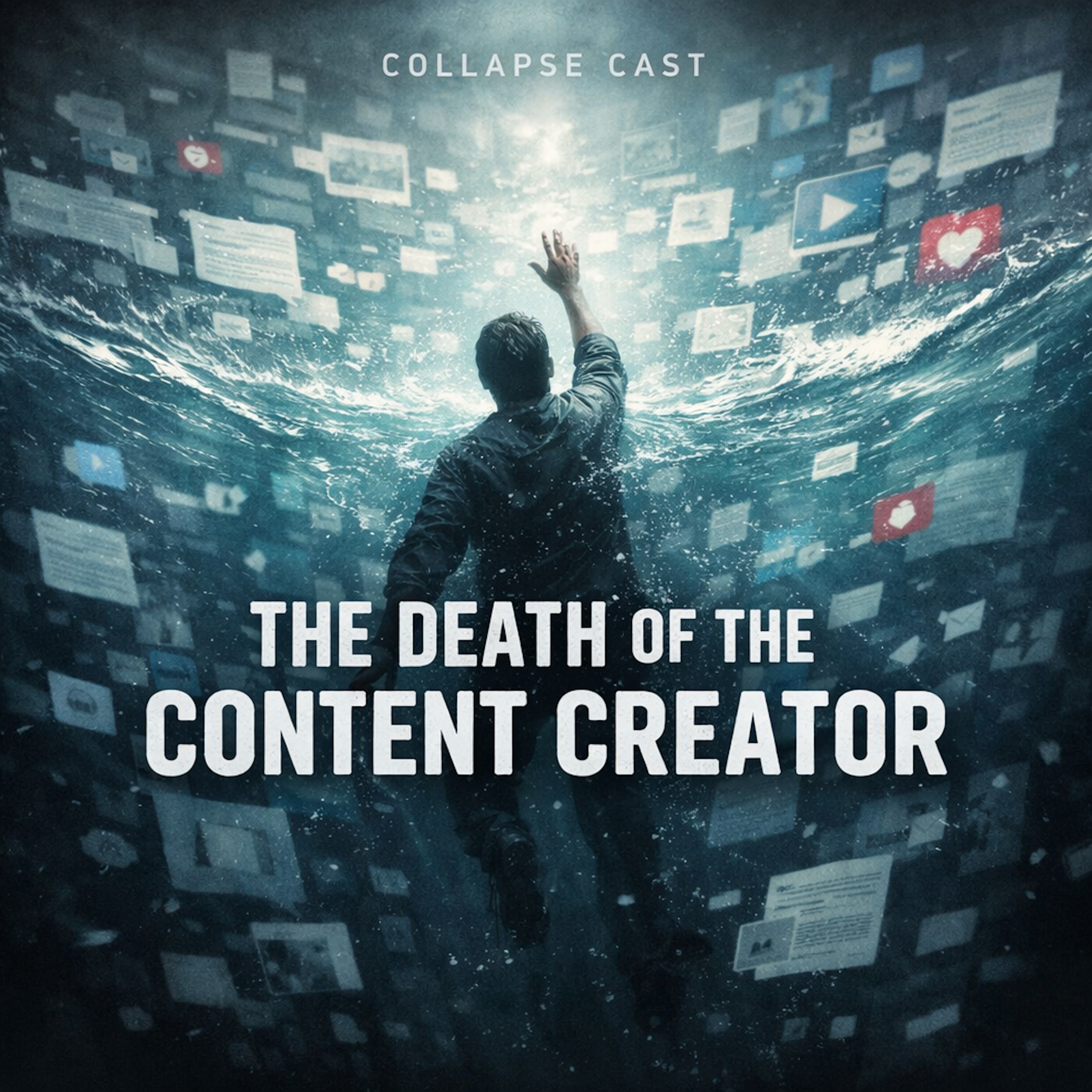
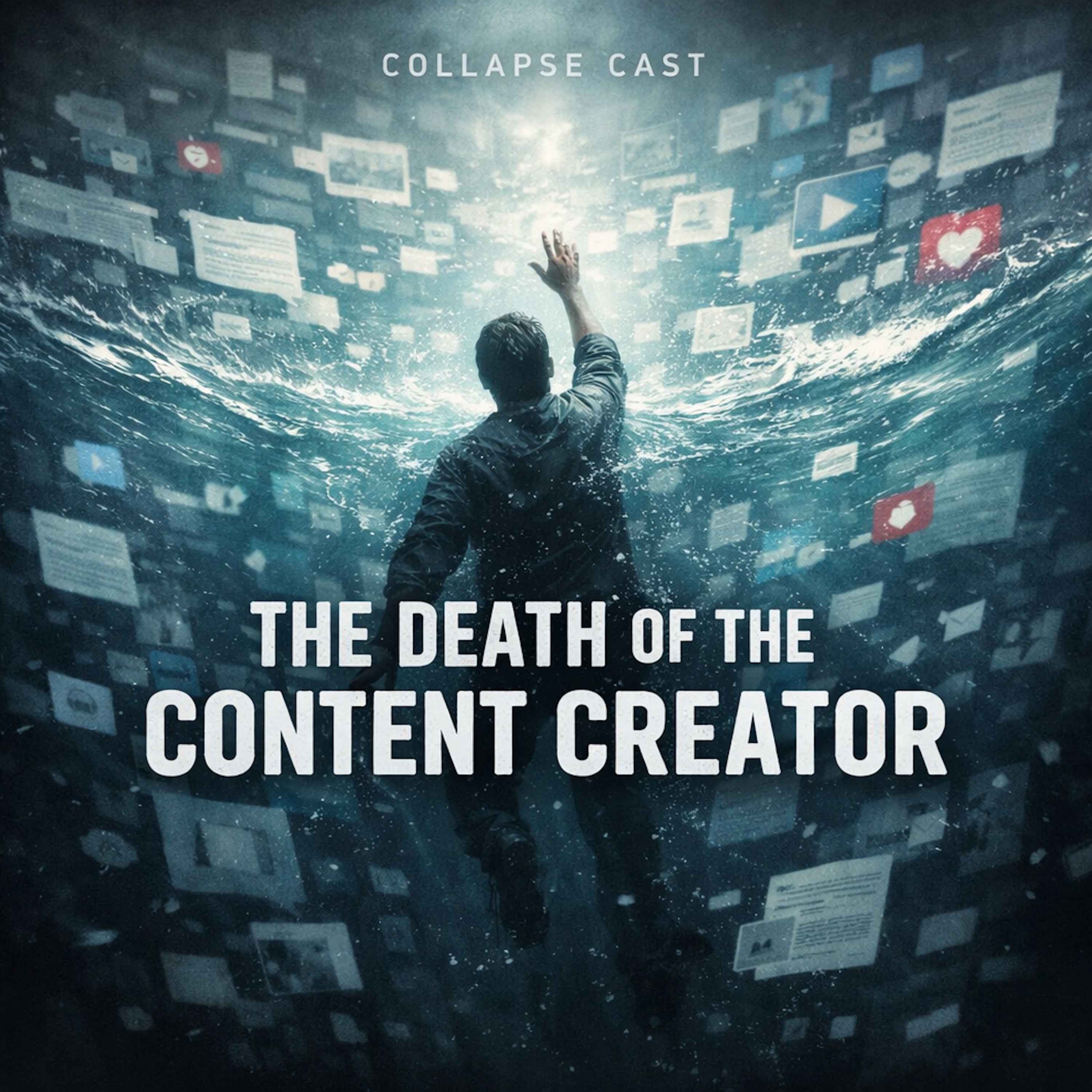
The problem isn't that AI replaced human creators. It's that the environment stopped requiring them. No one voted for this. It happened because systems did exactly what they were designed to do.
This collapse does not begin with artificial intelligence.
It does not begin with platforms, or algorithms, or any single decision made by any single company. It begins with volume — and volume changes everything that comes after it.
We are producing more creative material, across every medium, than any society in history has ever attempted to absorb. Books, audiobooks, music, art, scripts, short-form video, long-form essays, serialized fiction — generated continuously, at a rate that no human audience can evaluate, follow, or meaningfully navigate. What makes this moment different from every previous period of media expansion is that creation is no longer tied to human limits.
People used to get tired. They hesitated. They stopped. That friction mattered.
AI systems do not tire. The stream does not thin. It does not wait for response. It does not care whether anyone is listening.
The result is not better culture or worse culture. It is saturation. And saturation changes how everything in the system behaves.
The Flood and What It Does
The important thing to understand about the volume problem is that it did not require malicious intent. No one had to intend it.
The systems involved did exactly what they were designed to do: increase output, remove barriers, reduce friction, keep content moving. From a technical standpoint, this is success. Cultural systems do not collapse because they fail. They collapse because they succeed too efficiently in one direction.
No listener can meaningfully assess thousands of new audiobooks per week. No reader can evaluate endless streams of writing. No viewer can compare infinite videos. When the volume of incoming work exceeds the capacity to evaluate it, the system stops asking "is this good?" and starts asking "did this hold attention?"
Reaction scales. Judgment does not.
So as volume increases, the system defaults to what it can measure — clicks, completion rates, watch time, engagement velocity. These are not measures of quality. They are measures of response. And over time, the criteria for visibility quietly change.
Quality does not rise to the top. It dissolves into sameness.
When everything looks acceptable at a glance, nothing stands out as essential. Good work does not get rejected. It gets buried. That is the part people misunderstand. The flood does not erase human creativity. It makes it indistinguishable.
What Happens to Creators
Once the environment changes, behavior follows. And the first behavior to change is not consumption — it is initiation.
What is happening to creators right now is not burnout. Burnout comes from doing too much. What is emerging is something closer to deflation — when effort stops feeling meaningful, when the act of creation no longer connects to anything outside the creator themselves.
Most people who create do not enter this work because they expect success. They enter it because creating is how they think. How they process experience. How they make sense of being alive. But that act depends on a belief that usually goes unspoken — that effort matters. That care registers. That something made honestly might reach someone else as something more than noise.
In a saturated environment, that belief collapses quietly.
Creators look around and notice that their work is no longer entering a conversation. It is entering a stream. And streams do not respond. They move on.
Consumer enthusiasm for AI-generated creator content has already dropped from 60% in 2023 to 26% in 2025 — a signal that audiences can feel the change even when they cannot name it. Meanwhile, 59% of creators report concern about feed saturation, and 62% about increased competition from synthetic content and virtual influencers. They are competing not against other humans, but against an environment that produces endlessly.
In that environment, effort does not feel brave. It feels pointless.
So creators begin to self-edit — not their work, but their willingness. They stop starting projects that require emotional exposure. They stop committing to work that demands vulnerability. And once that belief breaks, ability no longer matters. Talent remains. Skill remains. The desire even remains. What disappears is the reason to begin.
There is a second response to this environment that is easier to miss. Not all creators leave. Some stay — but they disengage emotionally. They do not stop producing. They stop caring. They begin using the same tools flooding the environment — generating instead of crafting, supervising instead of inhabiting, prompting instead of speaking. On the surface it looks like adaptation. Psychologically, it is retreat.
This response actually accelerates the flood. Creators who have disengaged emotionally still add volume, even as meaning drains from the system. Output rises at the exact moment motivation collapses. That paradox confuses observers. More content than ever — but something feels thinner. Less alive.
The people who would have made riskier, stranger, more personal work never started. The environment selected for what remained. Work that does not require belief. Work that does not require vulnerability. Work that can be produced without expectation.
Signal Collapse and Audience Adaptation
Collapse does not complete when creators disengage. It completes when signal fails — and audiences adapt to that failure.
Signal is what allows people to tell the difference between what matters and what is merely present. In healthy creative systems, signal emerges naturally. People talk about work. Critics evaluate it. Communities argue about it. Reputation accumulates. But signal does not scale infinitely. When the volume of incoming work exceeds the capacity to evaluate it, signal collapses.
This is not a failure of taste or intelligence. It is a throughput problem.
As discovery becomes exhausting, people conserve effort. They skim instead of explore. They sample instead of commit. They trust recommendations over judgment. They stop expecting every piece of content to matter. The audience learns what works inside this environment — not what is meaningful, but what is easy to process.
Over time, expectation shifts. Depth becomes optional. Originality becomes risky. Strangeness becomes friction. And friction feels like failure in a saturated environment.
This is where authorship starts to fade. People stop asking "who made this?" and start asking "does this work?" Is it clear? Is it fast? Is it useful? When AI-generated narration sounds acceptable, when AI-written summaries feel functional, when AI explanations sound confident — the distinction between human and machine stops demanding attention. Not because anyone made a philosophical choice. Because repetition made the distinction feel unnecessary.
Normalization is where the collapse becomes invisible.
Audiences encounter synthetic content repeatedly. They find it functional. They stop questioning it. Repetition does what argument never could — it makes the unfamiliar feel ordinary. Gems still exist. Human-made work that feels alive, distinct, personal. But finding those gems now requires intentional effort, patience, a willingness to wade through noise. As the environment grows louder, fewer people are willing to do that work. Not because they do not care — because the system trained them not to expect discovery to pay off.
New users enter an environment where synthetic creation is simply how things are. They do not miss what came before. Human-made work becomes a niche preference. Artisanal. Optional. The audience no longer needs to believe a human is behind the work.
And once that belief fades, the incentive to create as a human fades with it.
Three Paths
After the flood, the deflation, and the signal collapse, the question becomes unavoidable: is it still worth creating as a human in an environment that no longer rewards human presence?
The system has produced a new kind of creator — not defined by expression, but by orchestration. They manage prompts, coordinate tools, track trends, optimize timing, deploy output. They do not live inside the work. They oversee it. This is not a failure of character. It is a rational response to an environment that rewards alignment over originality, volume over voice, responsiveness over depth.
Three paths have emerged.
The first is to continue creating as a human voice. Slow, risky, often invisible, driven by meaning rather than outcome. This path does not scale. It does not perform well in the current environment. But for some people it remains necessary — not because the system rewards it, but because abandoning it would mean abandoning something essential about themselves.
The second is to become an operator. To shift from maker to manager, from expression to coordination, from voice to throughput. This path produces visibility and results — but requires emotional distance. The work no longer reflects the person. It reflects the system's preferences.
The third path is quiet exit. Not dramatic, not political. People redirect their creative energy elsewhere, and because content keeps flowing, no one notices who left.
None of these paths are wrong. But they are not equivalent.
The question is not whether humans can still create. It is whether the conditions that once made human creation central to culture still exist. Those conditions were: a manageable signal-to-noise ratio, an audience with time and incentive to look for human work specifically, and a connection between effort and recognition that made beginning feel worth the risk.
Those conditions have not disappeared entirely. But they are no longer the default.
This is how the collapse stabilizes. Not through censorship or force. Through indifference. And indifference is far more stable.
CollapseCast — Death of the Content Creator traces this full arc: the mechanics of content saturation, what deflation does to the motivation to begin, how signal collapse changes what audiences can even evaluate, and what the three responses available to human creators actually cost. Not the end of creativity — but the death of the conditions that once made it feel necessary.